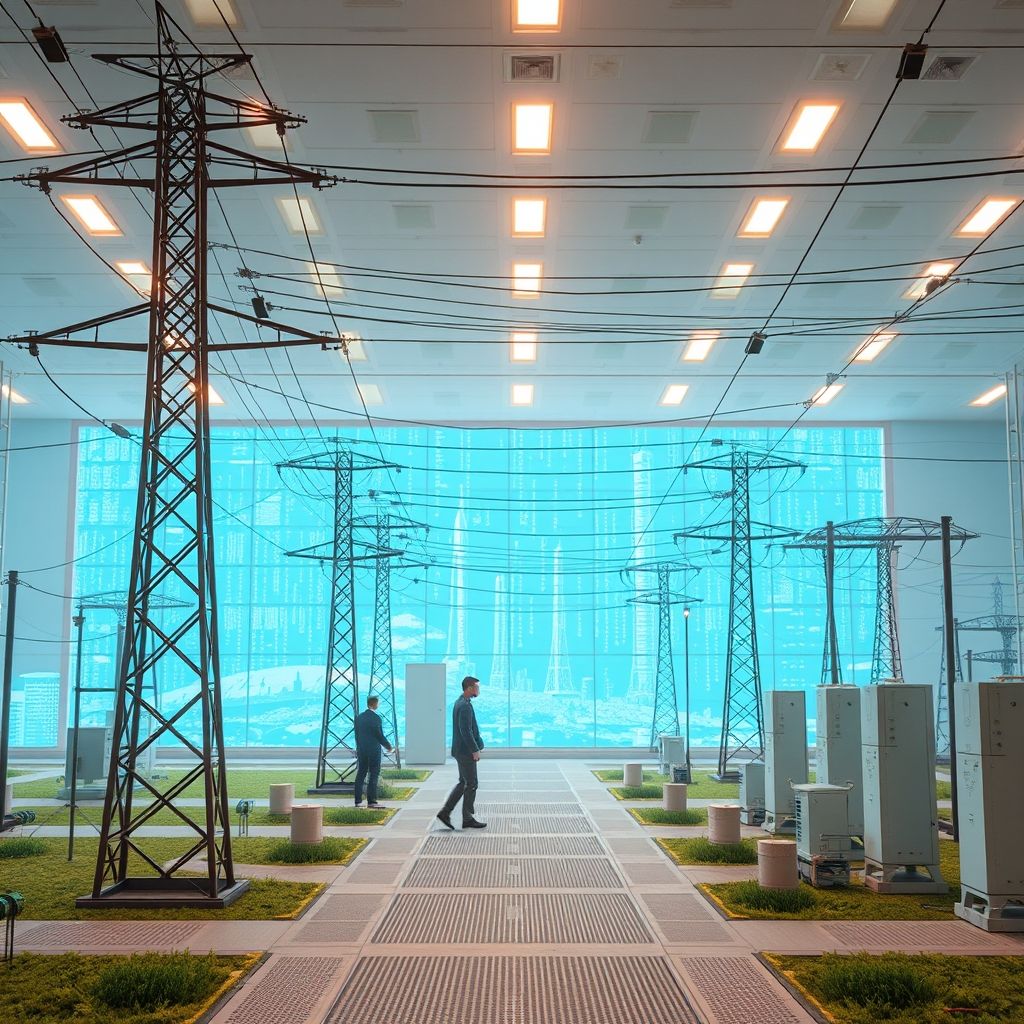
Stony Brook’s Digital Twin Studio: A New Frontier for Grid Resilience and Critical Infrastructure Intelligence
Stony Brook University is launching a Digital Twin Studio aimed at accelerating grid research and resilience. This initiative brings together sensors, AI, and simulation to strengthen utilities and critical infrastructure operations.
Introduction
Stony Brook University’s announcement of a new Digital Twin Studio marks a practical turning point for how academic research and utility operators can collaborate to strengthen the power grid. The studio promises a platform where real-world data, simulation models, and advanced analytics converge to support resilient operations, predictive maintenance, and accelerated innovation. For critical infrastructure owners and operators, the implications reach beyond academic curiosity: digital twins can materially change how assets are monitored, analyzed, and managed in day-to-day operations and emergency scenarios.
What Happened: The Digital Twin Studio Launch
The university is building a dedicated Digital Twin Studio designed to integrate sensor networks, measurement data, physics-based models, and machine learning tools to study and enhance grid behavior. The facility will host live experiments, synthetic scenarios, and joint projects with utilities and industry partners. Key capabilities include high-fidelity simulation of distribution and transmission components, ingestion of IoT sensor streams, and an environment for prototyping edge AI and computer vision algorithms for asset inspection.
Core components and partnerships
The studio blends hardware and software: distributed sensing platforms, secure data pipelines, cloud-native model execution, and interfaces for control-room workflows. Partnerships with regional utilities, equipment vendors, and federal research programs are expected to provide both data and operational use cases. The initiative is positioned as both a research hub and a sandbox for validating new technologies before field deployment.
Why This Matters for Critical Infrastructure Owners and Operators
Utilities face rising pressures from aging assets, extreme weather, cyber threats, and regulatory demands for reliability and resilience. A Digital Twin Studio addresses these pressures in three concrete ways: improving situational awareness, enabling predictive maintenance, and providing a testing ground for operational changes without exposing the live grid to risk.
Improved situational awareness
By fusing real-time telemetry from IoT sensors with physics-based grid models and AI-driven anomaly detection, operators can detect subtle deviations that precede failures. This leads to faster fault isolation, better load forecasting, and more informed restoration strategies during outages.
Predictive maintenance and asset life extension
Digital twins enable condition-based maintenance rather than calendar-based schedules. Predictive models that incorporate environmental, operational, and historical failure data can forecast equipment degradation and optimize replacement timelines—reducing costs and preventing catastrophic failures.
How Key Technologies Fit Together
Digital Twins and Physics-Based Modeling
Digital twins are virtual replicas of physical systems. For the grid, that means combining electrical network models, dynamic component behavior, and environmental factors. High-fidelity models allow scenario testing—such as how a substation reacts to extreme wind—or how distributed energy resources affect local voltage stability.
AI and Machine Learning
AI augments models by recognizing patterns across large datasets that are difficult to encode analytically. Machine learning models can accelerate load forecasting, detect cyber-physical anomalies, and prioritize inspection targets. In a studio environment, researchers can safely train and validate algorithms against both recorded events and synthetic edge cases.
Computer Vision and AI Inspection
Computer vision applied to drone imagery and fixed cameras can automate visual inspections of substations, poles, and lines. When tied into a digital twin, detected defects (corrosion, vegetation encroachment, damaged insulators) can be mapped to the asset model, triggering localized risk assessments and maintenance workflows.
IoT Sensors and Edge AI
Remote sensors measure temperature, vibration, partial discharge, and other indicators of equipment health. Edge AI enables initial data triage on-site—filtering noise, compressing telemetry, and issuing immediate alerts when thresholds are crossed. This reduces bandwidth needs and accelerates response times for field crews.
Practical Engineering and Operational Insights
Translating a digital twin from a lab to field utility requires attention to data fidelity, model governance, and integration with existing operational technology (OT). Practical considerations include:
Data quality and management
Sensors must be calibrated and time-synchronized. Ingested telemetry requires metadata and lineage to ensure models are trained on correct contexts. A data governance framework is essential to maintain trust in analytics used for operational decisions.
Model validation and uncertainty quantification
Engage operators in validation—what the model predicts should be interpretable and accompanied by confidence bounds. Quantifying uncertainty enables better risk-based decisions; operators need to know when to trust the twin and when human verification is required.
Interoperability with OT and SCADA
Digital twins must interface securely with supervisory control and data acquisition systems and asset management platforms. Adhering to standards (e.g., IEC, IEEE) and using defensible cybersecurity practices prevents the twin from becoming an attack vector.
Operationalizing insights
Deliver actionable outputs: prioritized work orders, dispatch recommendations, and dashboard views tailored to control room staff. Too much raw data without operational context limits adoption.
Future Industry Implications
Studios like Stony Brook’s accelerate a broader shift in how infrastructure is managed. Expect these trends:
Faster technology validation cycles
Digital twin studios reduce the time and cost to test new sensors, algorithms, and operational strategies by providing a realistic but controlled environment. This shortens time-to-deploy and reduces field risk.
Integrated asset intelligence ecosystems
Utilities will converge on federated twins—linked models representing transmission, distribution, and customer-side resources—to support holistic resilience planning. Shared twin templates will standardize best practices across regions.
From reactive to anticipatory operations
As digital twins and edge AI mature, operations will move from reacting to events to anticipating and mitigating them proactively—reducing outage minutes and improving safety.
Conclusion
Stony Brook’s Digital Twin Studio is more than an academic lab: it is a strategic platform for critical infrastructure innovation. By combining digital twins, AI, computer vision, IoT sensors, and edge processing, the studio provides the tools necessary to improve situational awareness, optimize maintenance, and stress-test resilience strategies. For utility owners and operators, the implication is clear: investing in integrated digital twins and the organizational processes to use them will be central to maintaining reliable, resilient service in the face of increasing climate, cyber, and operational challenges.