Critical Infrastructure
Intelligence Layer
Fusing high-frequency physical telemetry, multimodal IoT sensors, and real-time Digital Twins to protect bridges, rails, water supplies, and industrial plants from catastrophic failure.
Real-Time Telemetry & AI Command Dashboard
Interactive modal stress calculations, structural lean angles, and micro-strain telemetry combined into an operational glassmorphic twin console. Hover over pulsing radar hotspots to inspect live metrics.
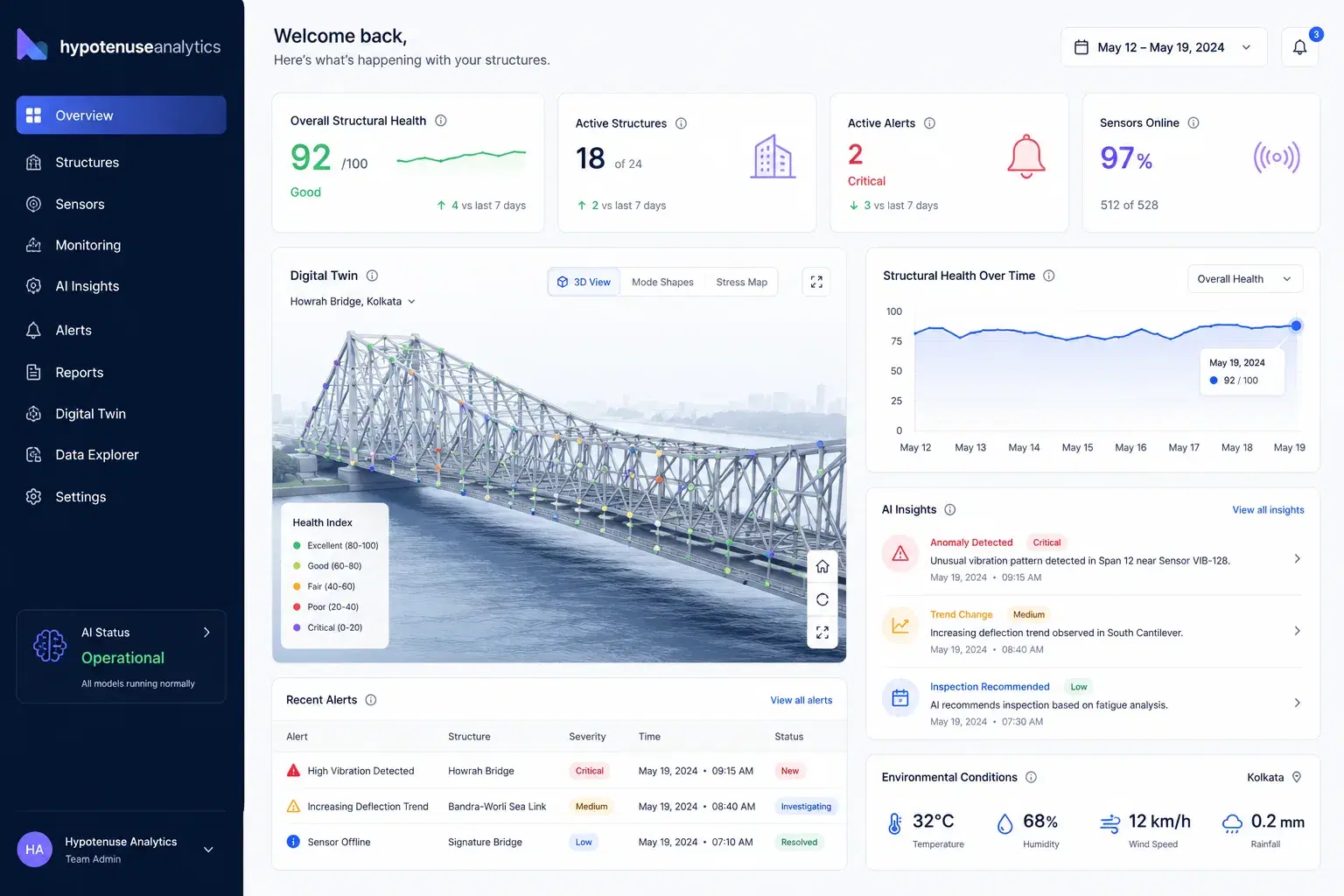
Modal Vibration Spectrogram
Real-time FFT analysis tracking bridge deck natural frequency response.
Micro-Strain Telemetry
Fiber-optic strain gauge detecting tension limits under heavy-haul passage.
Digital Twin Mesh
Auto-calibrated Finite Element Model (FEM) aligning physical sensor data with digital replica.
Dynamic Factor of Safety
AI calculating overall asset structural reserve capacity in real-time.
By Our Structural Intelligence Layer, Bridges get more than 30% Life Cycle Extensions
Undetected material fatigue progresses through hidden stages before structural collapse occurs. Our structura layer identifies early micro-changes, saving assets long before failure.
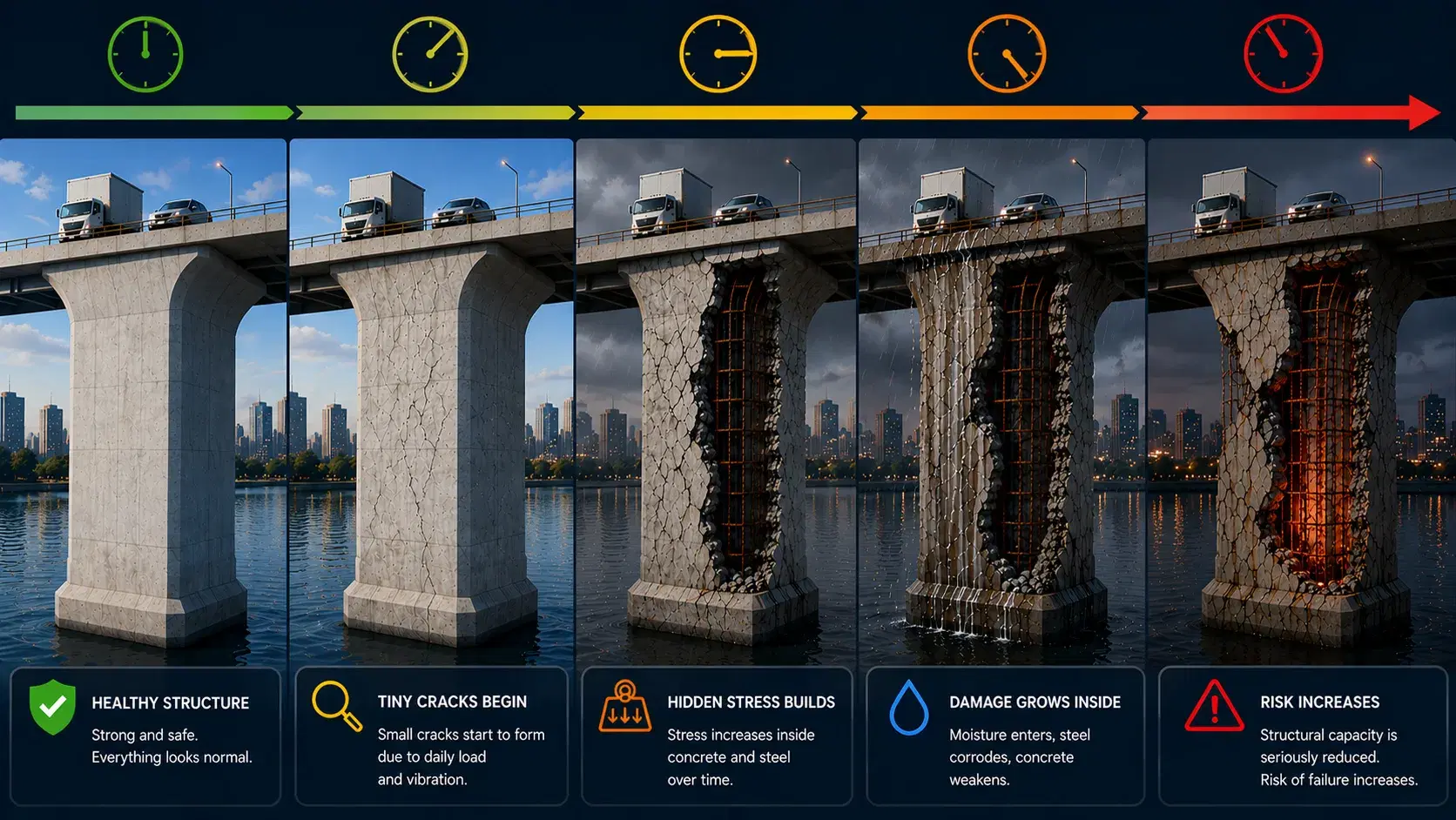
Healthy Structure
Strong and safe. Everything looks normal.
Continuous sensor baseline mapping. AI constructs initial normal finite-element patterns.
Tiny Cracks Begin
Small cracks start to form due to daily load and vibration.
PRIMARY INTERCEPT: Precision laser distance sensors & accelerometers flag hairline structural drift.
Hidden Stress Builds
Stress increases inside concrete and steel over time.
Fiber-optic strain sensors capture micro-strain spikes, flagging internal shear stress anomalies.
Damage Grows Inside
Moisture enters, steel corrodes, concrete weakens.
Ultrasonic scans and piezometers map moisture leakage rates and steel structural decay signatures.
Risk Increases
Structural capacity is seriously reduced. Risk of failure increases.
Digital twin model triggers critical priority alerts via SMS, dashboard, & SCADA weight shedding.
Verification Domains
Bridge & Highway Monitoring
Technical Capabilities
Railway & Metro Networks
Technical Capabilities
Dams & Reservoirs
Technical Capabilities
Asset Intelligence Deep Dives
Bridge Monitoring
- Challenges: Material fatigue, concrete creep, structural corrosion.
- Sensors Used: Tri-axial accelerometers, displacement strain gauges.
- AI Models: Finite Element response drift forecasting.
- Risk Indicators: Joint expansions, load limit exceedances.
- ROI Metric: +30% bridge operating lifecycle extension.
Railway Monitoring
- Challenges: Rail track buckling, heavy-haul ballast settlement.
- Sensors Used: Fiber-optic strain sensors, tiltmeters, track CCTV.
- AI Models: Geotechnical subsidence and curve shear models.
- Risk Indicators: Geometry deflection exceeding consent limits.
- ROI Metric: Zero structural failures over 42km active metro lines.
Smart Buildings
- Challenges: Foundation differential settlement, high-wind lean.
- Sensors Used: Laser distance meters, ambient vibration transducers.
- AI Models: Ambient excitation structural state monitors.
- Risk Indicators: Acceleration anomalies, partition cracking.
- ROI Metric: -45% routine manual structural inspection overhead.
Dams & Water Infrastructure
- Challenges: Piping erosion, internal clay core slippage.
- Sensors Used: Vibrating wire piezometers, settlement cells.
- AI Models: Seepage-to-reservoir hydraulic gradient correlates.
- Risk Indicators: Seepage discharge acceleration spikes.
- ROI Metric: 15-minute emergency evacuation warning window.
Industrial Facilities
- Challenges: Heavy rotating machinery foundation vibrations.
- Sensors Used: Acoustic emission sensors, vibration transducers.
- AI Models: Machinery vibration fatigue progression curves.
- Risk Indicators: Foundation micro-crack expansions.
- ROI Metric: -25% unplanned industrial facility downtime.
Power Plants
- Challenges: Cooling tower concrete aging, thermal structural cracks.
- Sensors Used: Thermal cameras, concrete crack gauges.
- AI Models: Structural thermal stress cycle predictors.
- Risk Indicators: Crack openings crossing critical limits.
- ROI Metric: Continuous compliance reporting without downtime.
Data Centers
- Challenges: Server rack vibration, cooling thermal imbalance, grid power fluctuations.
- Sensors Used: Precision vibration transceivers, thermal cameras, power quality analyzers.
- AI Models: Real-time thermodynamic fluid & grid load predictors.
- Risk Indicators: Chassis acceleration spikes, cooling node failures.
- ROI Metric: 99.999% uptime guaranteed, -18% cooling PUE overhead.
Large Solar Parks
- Challenges: Tracker mechanical wear, micro-cracks, environmental subsidence.
- Sensors Used: Pyranometers, tracker tiltmeters, drone thermal imagery sweeps.
- AI Models: Tracker angle alignment and soil settlement predictors.
- Risk Indicators: Torsional flutter anomalies, structural support lean.
- ROI Metric: +12% energy output capture, -40% manual panel alignment time.
Mining & Caverns
- Challenges: Cavern wall pressure buildup, borehole convergence, seismic shifts.
- Sensors Used: Laser distance convergence measures, micro-seismic geophones.
- AI Models: Geotechnical cavern subsidence and wall pressure shear correlates.
- Risk Indicators: Borehole convergence spikes, shear stress limit exceedances.
- ROI Metric: 99.9% shaft failure preemption, -30% safety audit overhead.