Structural Health Monitoring: The Sensor Landscape and What Problems It Can Solve
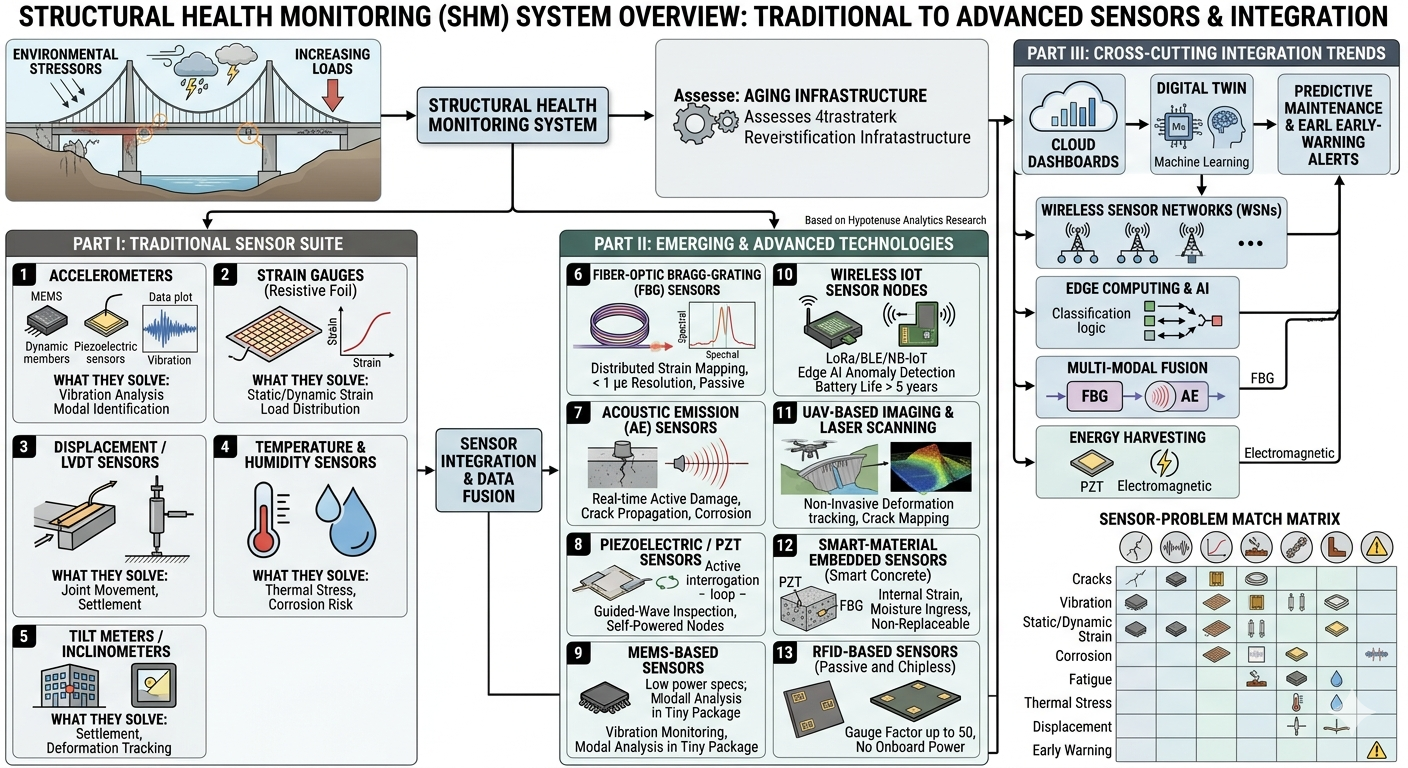
This comprehensive guide explores the full spectrum of Structural Health Monitoring (SHM) sensors—from traditional accelerometers and strain gauges to emerging FBG, AE, MEMS, IoT, and RFID technologies—and maps each sensor type to the specific structural problems it solves, including crack detection, vibration analysis, corrosion monitoring, and real-time early warning systems.
Introduction
Our infrastructure is aging. Bridges, buildings, pipelines, and dams that were built decades ago are now facing increasing loads, environmental stressors, and the relentless march of time. The question isn't if these structures will need attention—it's when.
Structural Health Monitoring (SHM) has emerged as the answer. By embedding sensors into or onto structures, we can continuously assess their condition in real time, detect problems early, and save both lives and money. But with so many sensor technologies available, what should you use? And what problems can SHM actually solve?
This blog post—based on Hypotenuse Analytics' latest deep research—provides a comprehensive overview of the sensor landscape for SHM, from traditional workhorses to cutting-edge innovations, and maps each technology to the specific structural problems it addresses.
Part I: The Traditional Sensor Suite
These are the proven, reliable sensors that have formed the backbone of SHM for decades. They're well-understood, cost-effective, and widely deployed.
1. Accelerometers
How they work: Accelerometers convert inertial motion into an electrical signal. Piezoelectric and MEMS-based versions dominate the market, offering bandwidths from 0.1 Hz to several kHz, sensitivities of 1-10 V/g, and sampling rates up to 10 kHz.
Deployment: Surface-mounted on structural members, embedded in concrete, or installed on temporary fixtures for modal testing. Networked arrays enable modal-parameter identification across entire bridges or tall buildings.
What they solve: Vibration analysis, modal identification, impact event detection, and early fatigue assessment. Accelerometers are the go-to choice for dynamic sensors in SHM due to their proven characteristics.
Best for: Bridges, high-rise buildings, aerospace airframes, and offshore platforms where dynamic response is critical.
Trend: Integration with wireless IoT nodes and edge AI for real-time anomaly detection.
2. Strain Gauges (Resistive Foil)
How they work: These sensors measure the change in electrical resistance under axial strain. Typical gauge factor ≈ 2, measurement range ±5,000 µε, and resolution down to 1 µε.
Deployment: Surface-bonded on steel, embedded in concrete, or incorporated into smart-concrete mixes.
What they solve: Static and dynamic strain monitoring, load distribution analysis, and thermal stress assessment.
Best for: Buildings, bridges, pipelines, and heritage monuments where localized strain is of interest.
Trend: Hybrid sensor networks combining strain gauges with fiber-optic multiplexing for distributed coverage.
3. Displacement / LVDT Sensors
How they work: Linear Variable Differential Transformers produce a voltage proportional to displacement, with ranges from 0.1 mm to several meters and resolution of 0.01 mm.
Deployment: Mounted across expansion joints, bridge bearings, or as part of settlement monitoring systems.
What they solve: Joint movement tracking, settlement detection, tilt measurement, and large-scale deformation monitoring.
Best for: Bridge bearings, tunnel linings, and large civil structures.
4. Temperature & Humidity Sensors
How they work: Thermistors or capacitive humidity elements provide accuracy of ±0.1°C and ±2% RH, with low power consumption enabling long-term deployment.
What they solve: Thermal stress analysis, corrosion risk assessment, and environmental monitoring—essential for compensating other sensors' temperature drift.
Best for: All infrastructure types, especially tunnels and offshore platforms where moisture ingress is critical.
5. Tilt Meters / Inclinometers
How they work: MEMS accelerometer-based inclinometers measure angle changes with resolution < 0.01°.
What they solve: Settlement detection, slope stability assessment, and post-earthquake deformation tracking.
Best for: Tall structures, dams, and heritage monuments.
Part II: Emerging and Advanced Sensors
The frontier of SHM is defined by sensors that offer greater sensitivity, distributed coverage, and the ability to detect damage as it happens—not just after the fact.
6. Fiber-Optic Bragg-Grating (FBG) Sensors
How they work: FBGs reflect a narrow wavelength that shifts linearly with strain and temperature. A single fiber can multiplex up to 100 sensors, with strain resolution < 1 µε. No electrical power is needed at the sensing point—they're completely passive.
Deployment: Surface-bonded, embedded in concrete, or distributed along long spans like bridge decks.
What they solve: Distributed strain mapping, crack initiation detection, temperature-induced stress analysis, corrosion-related expansion monitoring, and real-time oversight of large structures.
Best for: Bridges, tunnels, offshore platforms, aerospace composites, and heritage structures where long-term durability is essential.
Trend: High-speed multiplexed interrogation for dynamic events, combined with machine learning to discriminate strain from temperature effects.
7. Acoustic Emission (AE) Sensors
How they work: AE sensors detect transient elastic waves generated by micro-cracking, fiber breakage, or corrosion. Typical frequency range: 100 kHz–1 MHz. They can detect events as small as 10 dB.
What they solve: Real-time detection of active damage without needing a baseline. Crack initiation and propagation, impact events, fatigue damage, and corrosion-related acoustic signatures can all be identified.
Best for: Pressure vessels, pipelines, bridges, aerospace structures, and marine applications.
Trend: Integration with robotic NDE (Non-Destructive Evaluation) and AI-driven waveform classification for more reliable source location.
8. Piezoelectric / PZT Sensors
How they work: The direct piezoelectric effect converts mechanical strain into electrical charge. PZT ceramics offer high coupling coefficients and bandwidth up to several MHz. They can act as both actuators and sensors.
What they solve: High-frequency vibration monitoring, guided-wave inspection, active damage interrogation, and—crucially—energy harvesting for self-powered nodes.
Best for: Aerospace airframes, wind-turbine blades, bridges, and marine structures where active ultrasonic testing is valuable.
Market insight: The global PZT market is projected to reach $7.8 billion by 2033, reflecting expanding use in SHM.
9. MEMS-Based Sensors
How they work: Micro-electromechanical systems use silicon cantilevers or proof masses to sense acceleration, strain, or tilt. Typical acceleration range ±50 g, resolution < 0.01 g, and power consumption under 10 mW.
What they solve: Vibration monitoring, modal analysis, impact detection, and real-time health alerts—all in a tiny, low-cost package.
Best for: Buildings, bridges, and industrial machinery where dense sensor spacing is advantageous.
Recent work: High-performance MEMS accelerometers for concrete SHM demonstrate frequency-shift detection of stiffness loss.
10. Wireless IoT Sensor Nodes
How they work: Miniature platforms combine transducers (strain gauges, temperature sensors, etc.) with low-power radio (LoRa, BLE, NB-IoT), onboard ADC (up to 24-bit), and energy harvesting. Battery life > 5 years at 1 Hz sampling is achievable.
What they solve: Continuous strain, temperature, humidity, and tilt monitoring, with early-warning alerts via cloud dashboards.
Best for: Smart-city infrastructure, pipelines, and heritage structures where invasive wiring is undesirable.
Integration trend: Edge-computing nodes running AI models for on-device anomaly detection, reducing data transmission loads.
"Affordable sensors will enable the responsible authorities not only to monitor infrastructure in doubtful cases but also to establish structural monitoring on a wider scale."
— Fraunhofer researchers on the future of SHM
11. UAV-Based Imaging & Laser Scanning
How they work: Drones equipped with high-resolution photogrammetric cameras or LiDAR scanners capture 3D point clouds with centimeter-level accuracy.
What they solve: Displacement mapping, deformation tracking, crack mapping, settlement assessment, and surface-damage evaluation—all from a distance.
Best for: Bridges, dams, heritage monuments, and offshore platforms where access is difficult or dangerous.
Recent study: UAV photogrammetry combined with laser scanning provides high-resolution deformation maps for dam monitoring.
12. Smart-Material Embedded Sensors (Smart Concrete)
How they work: Sensors such as piezoelectric patches, fiber-optic FBGs, or wireless tags are cast directly into high-performance concrete during batching. They inherit the concrete's durability and can survive harsh environments for decades.
What they solve: Real-time monitoring of strain, crack initiation, moisture ingress, and thermal effects throughout the structural volume.
Best for: New bridge decks, tunnel linings, and high-rise foundations.
Challenge: Sensor replacement is impossible once embedded, and calibration can be complex.
13. RFID-Based Sensors (Passive and Chipless)
How they work: Passive RFID tags incorporate LC resonators whose resonance frequency shifts with strain or crack width. Gauge factors up to 50 for strains < 1%—and no onboard power needed.
What they solve: Strain monitoring, crack width estimation, corrosion detection, and identification of localized damage without cabling.
Best for: Large-scale civil infrastructure, aerospace panels, and industrial pipelines where periodic wireless checks are sufficient.
Key demonstration: A high-sensitivity RFID strain sensor with gauge factor 50 successfully detected sub-1% strain in composites. Chipless RFID designs can now simultaneously encode ID and characterize cracks or corrosion from 15 cm away with a portable reader.
Part III: Cross-Cutting Integration Trends
No single sensor type can do it all. The real power of SHM comes from integration.
Wireless Sensor Networks (WSNs)
The past decade has seen robust, low-power mesh protocols (LoRaWAN, Thread, etc.) enabling thousands of nodes on a single bridge, reducing installation time by roughly 30%.
Edge Computing & AI
Embedding lightweight neural networks on sensor gateways allows real-time feature extraction—AE waveform classification, modal parameter drift detection—and reduces cloud bandwidth by up to 24%.
Multi-Modal Fusion
Combining FBG strain data, AE event counts, and accelerometer vibration spectra significantly improves damage localization accuracy. Hybrid SHM platforms for bridges now routinely fuse these data streams.
Energy Harvesting
PZT and piezoelectric cantilevers are being used to scavenge ambient vibrations, powering wireless nodes and extending battery-free operation.
Digital Twins
The concept of an intelligent digital twin—integrating machine learning and AI for bridge data management—is becoming a reality. These virtual replicas of physical structures enable predictive maintenance and lifecycle planning.
Part IV: Sensor-Problem Match — A Quick Reference
| Problem | Recommended Sensors |
|---|---|
| Crack initiation & propagation | AE sensors, FBGs, chipless RFID tags, smart concrete |
| Vibration & modal analysis | Accelerometers (including MEMS), piezoelectric actuators, UAV photogrammetry |
| Static/dynamic strain & load | Strain gauges, PZT patches, FBG arrays, wireless IoT strain nodes |
| Corrosion & moisture ingress | Temperature/humidity sensors, AE monitoring, RFID tags |
| Fatigue & impact events | High-frequency AE, piezoelectric ultrasonic transducers, high-speed MEMS |
| Thermal stress & expansion | Temperature sensors, FBG temperature compensation |
| Displacement, tilt, settlement | LVDTs, tilt meters, UAV/LiDAR surveys, wireless inclinometers |
| Early-warning/real-time alerts | Wireless IoT networks with edge AI, passive RFID, cloud-connected AE |
Conclusion
Structural Health Monitoring is no longer a niche research topic—it's a practical, rapidly evolving field that's saving lives and extending the service life of our critical infrastructure.
Each sensor class brings a unique combination of sensitivity, deployment flexibility, and cost. The optimal SHM suite depends on your structural asset's material, geometry, environmental exposure, and the specific failure modes you're most concerned about.
The clear trend is toward hybrid systems that fuse complementary modalities—FBG strain data with AE event streams, accelerometer vibrations with UAV imagery—while leveraging low-power wireless back-ends and edge analytics to deliver actionable, real-time health insights.
At Hypotenuse analytics, we're committed to helping researchers, engineers, and infrastructure managers navigate this complex landscape. Our research agents are designed to autonomously search, extract, and synthesize information from multiple sources, delivering comprehensive reports that cut through the noise.
Whether you're monitoring a century-old bridge, a towering skyscraper, or a critical pipeline, the sensors are ready. The question is: what problem are you trying to solve?